





Canted Coil Contact Spring Manufacturing Guide | Yinfeng
SPRING MACHINE GUIDE | PRECISION CONTACT SPRINGS
Canted Coil Contact Springs: Manufacturing Process, Applications and CNC Spring Machine Selection
Understanding inclined coil geometry, electrical contact performance and precision spring manufacturing requirements.
Canted coil contact springs, also known as canted coil springs, slanted coil springs or inclined coil contact springs, are precision wire-formed components featuring intentionally inclined helical coils. Their unique geometry allows the coils to deflect under an applied load, making them suitable for electrical connections, mechanical retention and electromagnetic shielding applications.
Unlike conventional cylindrical compression springs, canted coil springs require specific control over coil inclination, spring geometry, contact force and dimensional consistency. Manufacturing may involve precision CNC coiling, dedicated forming tooling and additional joining or finishing operations depending on the product design.
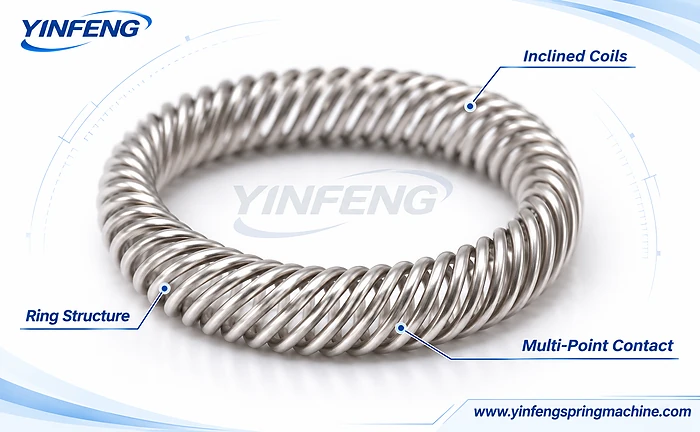
Figure 1. Circular canted coil contact spring showing the inclined coil arrangement and ring structure.
Inclined Coil Geometry
Controlled coil deflection
Multiple Contact Points
Electrical contact interfaces
Precision Manufacturing
Specialized forming requirements
1. What Is a Canted Coil Contact Spring?
A canted coil spring is a helical spring whose individual coils are intentionally inclined relative to the spring's longitudinal direction. This inclination creates a particular force-deflection response when the spring is compressed in its intended loading direction.
Depending on the design, canted coil springs may be manufactured as straight lengths or assembled into closed circular rings. Some designs primarily provide mechanical retention or locking functions, while others are engineered for electrical contact or EMI/RFI shielding.
In electrical connector applications, a conductive canted coil spring may be positioned inside a groove between mating conductive components. During assembly, individual coils deflect and create multiple contact locations.
Technical Distinction: Contact Finger Spring vs. Tulip Contact Spring
The term "contact finger spring" can describe different electrical contact components. A canted coil contact spring uses inclined helical coils as part of the contact interface. In a tulip-type switchgear contact, separate metallic contact fingers may be held under pressure by a surrounding retaining or pressure spring. These structures have different manufacturing requirements and should not be treated as identical products.
2. How Canted Coil Springs Work in Electrical Connectors
Electrical contact reliability depends on contact geometry, normal force, material conductivity, surface condition and operating environment. A properly engineered conductive canted coil spring can provide a compact connection interface with multiple contact points.
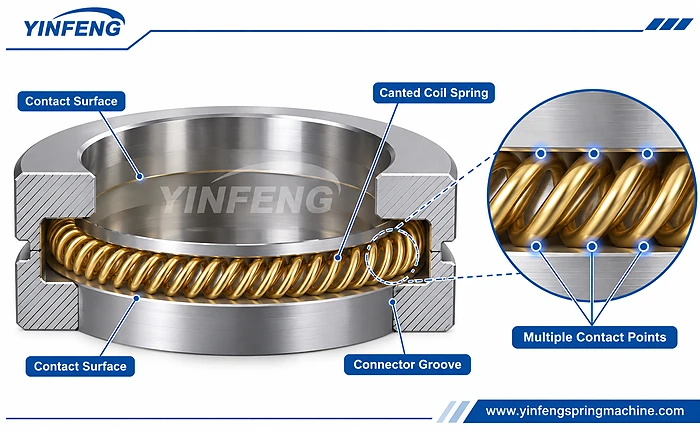
Figure 2. Conceptual connector cross-section illustrating a canted coil spring seated in an annular groove and contacting adjacent conductive surfaces.
Multiple Electrical Contact Points
Individual conductive coils can establish multiple contact locations against mating surfaces, depending on the connector's groove design and assembly geometry.
Controlled Contact Force
Coil inclination and spring geometry can be designed to provide a suitable force-deflection response over the intended operating range.
Tolerance Compensation
Elastic deformation helps accommodate dimensional variation and limited relative movement between connected components.
Compact Connector Integration
Closed-ring canted coil springs can be installed in annular grooves where the available connection space is limited.
Important:A canted coil shape alone does not guarantee electrical conductivity, low contact resistance, high-current capability or EMI shielding performance. These properties depend on the spring material, coating, contact design and complete assembly testing.
3. Typical Industries and Applications
Canted coil springs are used in mechanical and electrical systems where controlled contact force, compact geometry or reliable mechanical engagement is required.
Power Distribution and Switchgear
Specialized spring contact interfaces used in selected power connections, switchgear components and electrical distribution assemblies.
Industrial Electrical Connectors
Conductive contact spring rings for compact mating connections and assemblies requiring multiple electrical contact points.
Electric Vehicles and Energy Systems
Application-specific spring contacts for selected power interfaces and electrical connection systems.
Aerospace and Precision Electronics
Compact connector contacts and electromagnetic shielding interfaces where application requirements justify the spring design.
Canted coil springs may also serve mechanical retention, latching and locking functions in industrial equipment. The spring's material, dimensions and performance requirements must be selected for the intended application.
4. Key Design Parameters for Canted Coil Contact Springs
Successful manufacturing requires more than a basic wire diameter specification. The spring drawing should define the geometry, material and functional requirements that influence forming accuracy and contact performance.
| Design Parameter | Manufacturing Consideration |
|---|---|
| Wire Diameter | Affects forming resistance, spring stiffness and tooling selection. |
| Coil Inclination Angle | A critical geometry parameter influencing deflection behavior and spring performance. |
| Coil Height and Width | Determine the spring profile and required installation space. |
| Coil Pitch and Spacing | Affect coil distribution and dimensional consistency. |
| Material and Surface Finish | Influence strength, corrosion resistance and electrical interface behavior. |
| Spring Length or Ring Diameter | Must correspond to the finished product and connector dimensions. |
| Spring Force and Deflection | Must meet specified mechanical loading conditions. |
| End-Joint Structure | Requires additional assessment for closed-ring spring designs. |
5. How Are Canted Coil Contact Springs Manufactured?
Manufacturing an inclined-coil contact spring requires controlled wire forming and suitable tooling. Depending on the spring design, production may include precision coiling, secondary forming, cutting, ring joining, finishing and quality inspection.
Conventional compression spring forming capability does not automatically establish the ability to make canted coil springs. The forming arrangement must be evaluated against the required inclined-coil geometry.
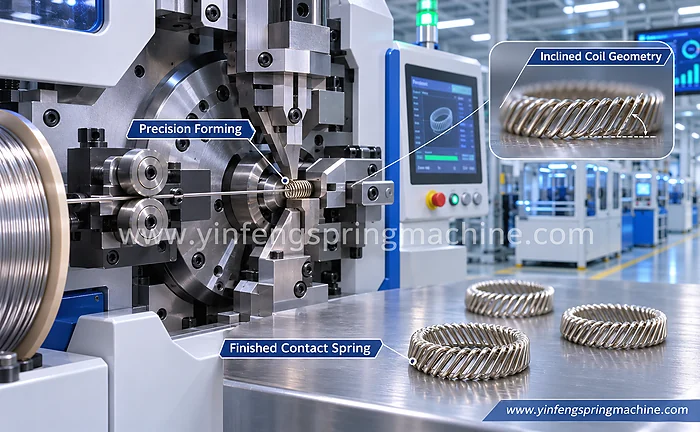
Figure 3. Conceptual illustration of precision spring forming and inclined-coil geometry. Equipment configuration is illustrative and does not represent a verified production trial on a specific Yinfeng machine.
TYPICAL MANUFACTURING WORKFLOW
01 Wire and Material Preparation
02 Precision Coil Forming
03 Inclination and Geometry Control
04 Spring Cutting and End Preparation
05 Ring Joining Where Required
06 Finishing and Quality Inspection
Wire Preparation and Material Evaluation
Production begins with selecting a suitable material and preparing the wire. Wire diameter, mechanical strength, surface condition and forming properties must be compatible with the intended spring geometry.
Precision Coil Forming
The wire is formed into a helical structure through a suitable coiling or wire-forming process. Unlike ordinary cylindrical springs, the forming setup must accommodate the specific inclined-coil profile.
Inclination and Dimensional Control
Coil inclination, cross-sectional dimensions, pitch and overall spring length are controlled according to the product drawing. Special tooling or additional forming operations may be required to achieve the specified geometry.
Cutting and Ring Joining
For closed-ring products, the prepared spring ends are joined through an appropriate method. Welding or other joining techniques may be considered depending on the material, spring design and functional requirements.
Finishing and Inspection
Depending on application requirements, finishing operations may include suitable heat treatment, surface treatment or conductive plating. The finished spring should be inspected for dimensional accuracy, spring force, end-joint quality and relevant electrical properties.
6. CNC Spring Machine Selection for Canted Coil Springs
Canted coil spring production requires an equipment evaluation based on actual spring geometry. CNC spring coiling machines may provide programmable wire feeding and coil-forming control, but not every standard coiling machine can produce inclined coils to the required dimensions.
Depending on the product, manufacturing may require dedicated tooling, modified forming movements or secondary processing equipment.
Equipment Evaluation Checklist
Wire diameter and material
Required coil inclination
Coil height, width and pitch
Spring length or ring diameter
Dimensional tolerances
Required spring force
Forming-tool configuration
Cutting and joining requirements
Target production capacity
Why Sample Evaluation Matters
Two contact springs with similar overall dimensions may require different forming arrangements because of their inclination angles, wire materials and tolerance requirements.
A detailed product drawing or physical sample allows the equipment manufacturer to evaluate the forming method, tooling design and possible secondary operations before recommending a machine.
Yinfeng supplies CNC spring forming and coiling equipment for different wire sizes and spring structures. Customers interested in canted coil spring manufacturing can submit drawings and samples for technical feasibility evaluation.
For general equipment information, exploreYinfeng CNC Spring Coiling Machinesand theSpring Machine Guide. Suitability for canted coil spring production must be confirmed for the specific product rather than assumed from a standard wire-diameter range.
7. Quality Control for Electrical Contact Springs
Dimensional consistency alone is not sufficient for an electrical contact spring. Quality requirements should be defined according to the spring's function in the finished electrical or mechanical assembly.
Verify wire diameter, coil dimensions, inclination angle, pitch and ring size.
Measure the spring response under specified installation and operating conditions.
Examine alignment and joint integrity where the product is manufactured as a closed ring.
Check surface condition, corrosion protection and conductive coatings when specified.
Evaluate contact resistance and relevant electrical properties in the assembled contact system.
Frequently Asked Questions
What is the difference between a canted coil spring and a regular coil spring?
A canted coil spring has intentionally inclined helical coils. A conventional cylindrical spring generally uses a different coil orientation. This changes how the spring responds to loading and influences its suitability for electrical contact or mechanical retention applications.
Are canted coil springs used as electrical contact springs?
Yes. Conductive canted coil spring designs can provide multiple electrical contact points in connectors, power contact assemblies and specialized electrical interfaces when correctly engineered and tested.
Can CNC spring machines manufacture canted coil springs?
CNC spring forming equipment can be used when its tooling and mechanical configuration can achieve the required inclined-coil geometry. Compatibility must be verified through the actual spring drawing, material and production requirements.
Do all canted coil springs need to be welded into rings?
No. Some canted coil springs are supplied in straight lengths, while others require a closed-ring configuration. Whether welding or another joining method is needed depends on the spring design and application.
What materials are used for electrical contact finger springs?
Material selection depends on the required spring force, conductivity, corrosion resistance, operating temperature and fatigue properties. Conductive copper alloys and suitably plated spring materials are used in different electrical contact applications.
Are canted coil springs the same as tulip contact pressure springs?
No. Canted coil contact springs use inclined coils as part of the contact or spring element. Tulip contact assemblies commonly use separate metallic contact fingers held under pressure by retaining springs. Their structures and manufacturing methods differ.
What determines the electrical performance of a contact spring?
Important factors include material conductivity, contact force, surface condition, plating, contact geometry and operating environment. Final contact resistance and current-carrying performance should be evaluated in the complete assembly.
What information should customers provide for machine evaluation?
Customers should provide wire diameter, material, coil dimensions, inclination angle, spring length or ring diameter, tolerances, sample photographs and target production volume. Physical samples are especially useful for evaluating the feasibility of specialized forming operations.
Technical Summary
Canted coil contact springs combine inclined helical geometry with application-specific mechanical properties. Conductive versions can provide multiple contact points in electrical connectors, while other variants may serve retention, locking or shielding functions.
For manufacturers evaluating CNC spring production equipment, the primary requirements are the actual inclined-coil geometry, material characteristics, dimensional tolerances and functional performance targets. Tooling and process feasibility should be confirmed before selecting a machine.
PRECISION SPRING MANUFACTURING EVALUATION
Need a CNC Spring Machine for Contact Spring Production?
Send Yinfeng your canted coil spring drawing, wire diameter, material, coil dimensions and production requirements. Our technical team can evaluate the required forming geometry and discuss suitable CNC spring manufacturing equipment and tooling options.
Contact YinfengExplore Spring Machines